Guide
How to Choose a Web Development Company in India: 15 Questions to Ask
A simple 4-step process and 15 questions to ask before you hire a web development company in India, covering experience, itemised quotes, payment terms, testing, code ownership and support.
Accelfied team 7 min read
Picking a web development company in India is easy to get wrong. Thousands of agencies, most with polished portfolios and five-star claims, and quotes for the same brief that range from ₹50,000 to ₹5 lakh. The cost of a wrong choice is not just money: it is months of delay, a site you cannot edit, or code nobody else wants to touch.
This guide gives you a simple process and the 15 questions to ask before you hire a web development company, written for Indian businesses and startups in 2026.
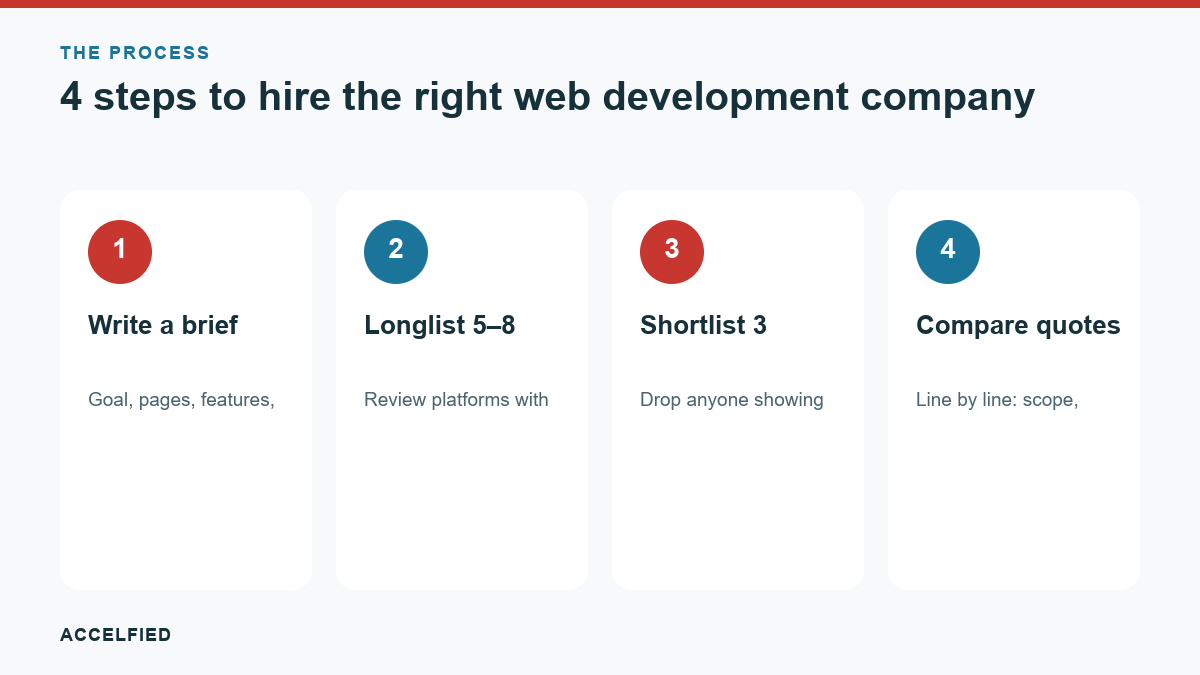
Step 1: Write a one-page brief before you call anyone
Agencies quote what you describe. A vague brief gets you vague, padded quotes. Your brief should cover:
- Goal: what the website must achieve (leads, online sales, bookings, credibility).
- Pages and features: a simple list (for example, Home, Services, 12 product pages, blog, enquiry form, Razorpay checkout).
- Integrations: CRM, WhatsApp, payment gateway, shipping, ERP or accounting software.
- Content: who writes the text and provides photos.
- Examples: 3 websites you like and why.
- Budget range and deadline. Sharing a range is not a weakness; it saves both sides time.
Step 2: Build a longlist of 5 to 8 companies
Good places to look:
- Review platforms with verified client reviews. On Accelfied you can filter web development companies in India by city, rate and minimum project size, and read verified reviews.
- Referrals from businesses in your industry.
- Portfolios of sites you admire (check the footer credit).
Location still matters in India. A team in your own city is easier to meet for workshops; a team in a tier-2 city like Jaipur, Indore or Coimbatore is often 15 to 30 percent cheaper than metros for the same quality. See our list of the best web development companies in Jaipur for an example.
Step 3: Shortlist 3 using these red flags
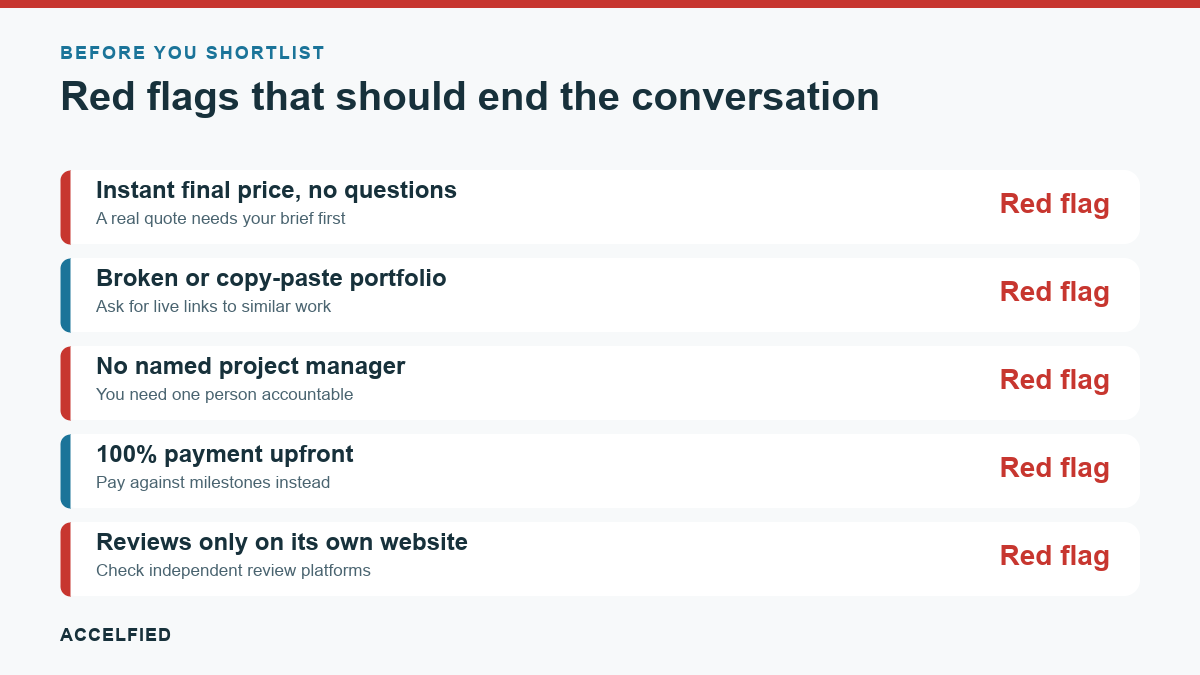
Drop a company if:
- It quotes a final price within an hour without asking questions.
- Its portfolio links are broken or all point to the same template.
- It cannot name the person who will manage your project.
- It refuses to put scope, timeline and payment milestones in writing.
- It asks for 100 percent payment upfront.
- All its reviews are on its own website and none are on independent platforms.
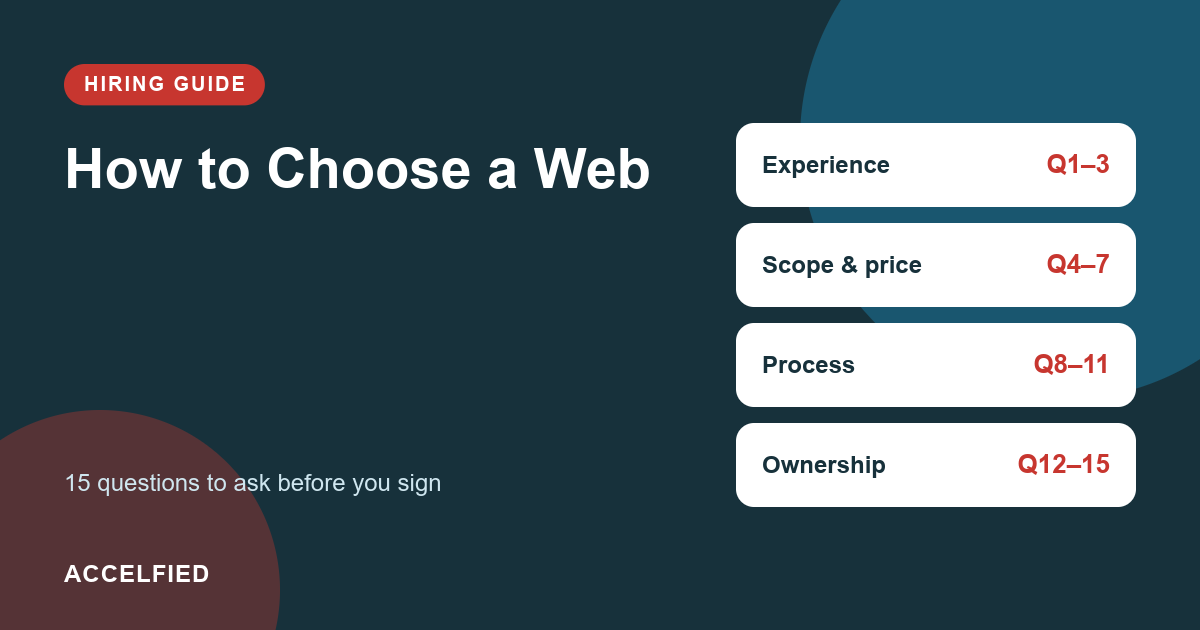
The 15 questions to ask before you sign
About experience
1. Have you built something similar in the last 12 months? Can I see it live? Ask for live links, not screenshots. Similar means the same type (ecommerce, booking, portal), not the same industry.
2. Can I speak to one or two of those clients? A confident company will connect you. Ask the client about communication, deadlines and what happened when something went wrong.
3. Who exactly will work on my project, and how senior are they? You want names and roles: project manager, designer, developers, tester. Ask whether any part will be subcontracted.
About scope and price
4. Can you give me an itemised quote? Design, development, content, integrations, testing and support should be separate lines. It shows the company has actually thought about your brief, and it makes it easy to compare quotes. Our website development cost in India guide shows typical ranges.
5. What is not included? Domain, hosting, paid themes or plugins, stock photos, copywriting, SEO and app store or Shopify fees are common surprises.
6. How do you handle change requests? Changes will happen. Agree on how they are estimated and approved before work starts, so the final bill does not double.
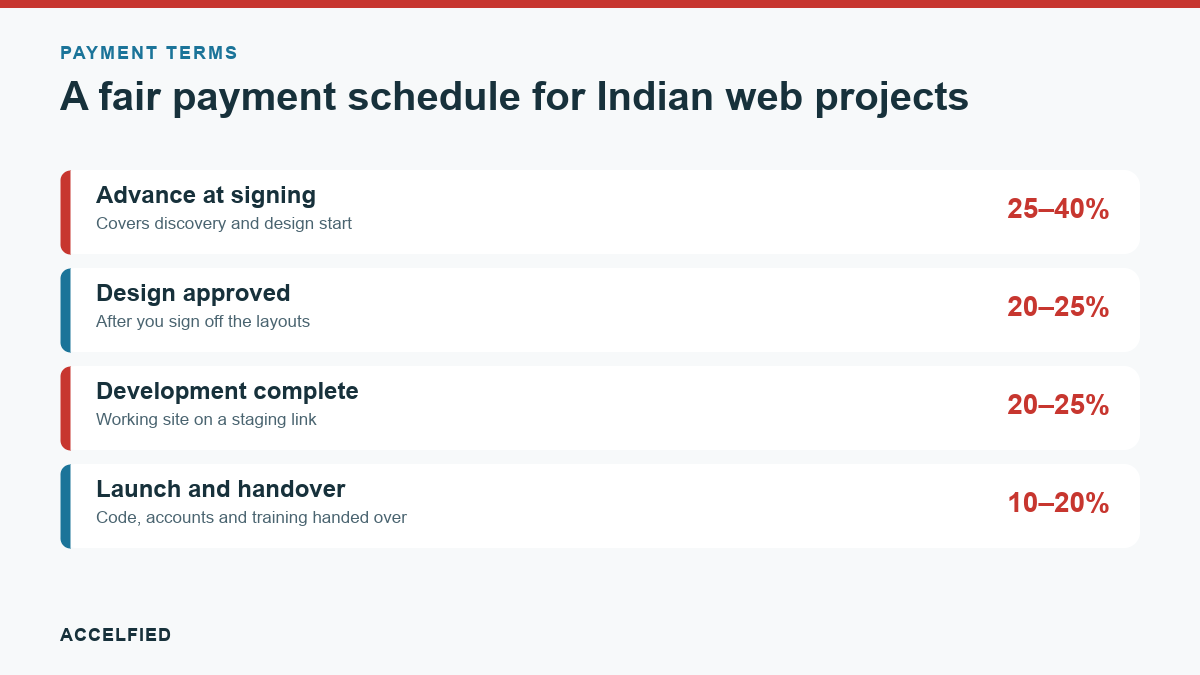
7. What is the payment schedule? A fair structure in India is 25 to 40 percent advance, then payments tied to milestones (design approved, development complete, launch). Avoid paying the full amount before you see working pages.
About process and quality
8. What does your process look like, week by week? Look for discovery, wireframes or design, development in sprints, testing, and a launch checklist. Ask how often you will see progress (weekly demos are a good sign).
9. Which technology will you use, and why? WordPress, Shopify, Webflow, Next.js or a custom stack are all fine for different needs. The answer should be about your goals, your budget and who will maintain the site, not just "what we always use".
10. How do you test before launch? Ask about mobile testing on real devices, browser testing, form and payment testing, page speed checks and basic security checks.
11. Will the site be fast and SEO-ready at launch? You want clean URLs, page titles and meta descriptions, a sitemap, schema markup, compressed images and a good Core Web Vitals score. Fixing these later costs more.
About ownership and support
12. Who owns the code, design files, domain and hosting accounts? It should be you, in writing. Domain and hosting should be registered in your company's name and email.
13. What happens after launch? Ask how many months of free bug fixes are included (1 to 3 months is common), and what a monthly maintenance plan costs (often ₹2,000 to ₹15,000 per month).
14. Will you train my team to update the site? A 30 to 60 minute recorded session and a short guide save you from paying for every text change.
15. What happens if we stop working together? You should get the full source code, admin access and documentation. A company that hesitates here is a risk.
Step 4: Compare quotes the right way
Put your 3 quotes side by side and compare:
- Scope covered (line by line, not the total)
- Team and seniority
- Timeline and milestones
- Support period after launch
- Ownership terms
- Verified reviews from projects like yours
The cheapest quote is usually missing something. The most expensive is not automatically the best. Pick the company that understood your brief best and showed it in their questions.
Freelancer, small studio or big agency?
- Freelancer: best for simple sites under about ₹50,000 with a clear brief. You manage the project yourself.
- Small studio (5-50 people): best for business websites, Shopify stores and first product versions. Senior people usually work on your project.
- Mid-size agency (50-250 people): best for custom web apps, ecommerce platforms and long-term work with proper QA.
- Large firm (250+ people): best for enterprise projects with strict compliance or very large teams.
Find and compare web development companies on Accelfied
Accelfied lists web development companies across India with verified client reviews, hourly rates and minimum project sizes. Browse web development companies in India, filter by your city, or post your project and get matched with companies that fit your brief and budget.
FAQs
How do I check if a web development company is genuine?
Check its company registration and GST number, read reviews on independent platforms (not only its own website), ask for live project links, and speak to at least one past client.
How much advance should I pay a web development company in India?
Usually 25 to 40 percent at the start, with the rest linked to milestones such as design approval, development completion and launch.
Should I choose a local company or one in another city?
If you need regular in-person meetings, choose a local company. Otherwise a company in another city can work just as well over video calls, and tier-2 cities often offer better rates.
How long should a web development company take to build my website?
A business website usually takes 3 to 8 weeks, an ecommerce store 4 to 10 weeks, and a custom web application 3 to 6 months. Be wary of promises that sound much faster than this.
- hiring guide
- web development
- india
- outsourcing