Guide
How to Hire a Custom Software Development Company in India: 8 Steps
A practical 8-step guide to hiring a custom software development company in India, with real 2026 prices, engagement models, contract must-haves and red flags.
Accelfied team 7 min read
Custom software is one of the biggest technology spends a business makes. A billing system, an ERP module, a customer portal or a SaaS product can cost anywhere from ₹5 lakh to well over ₹1 crore in India, and it will run your operations for years. Hire the wrong company and you lose more than money: you lose months, and sometimes the source code itself.
This guide walks you through hiring a custom software development company in India in 8 practical steps, with the questions to ask, the prices to expect and the red flags that should end a conversation.
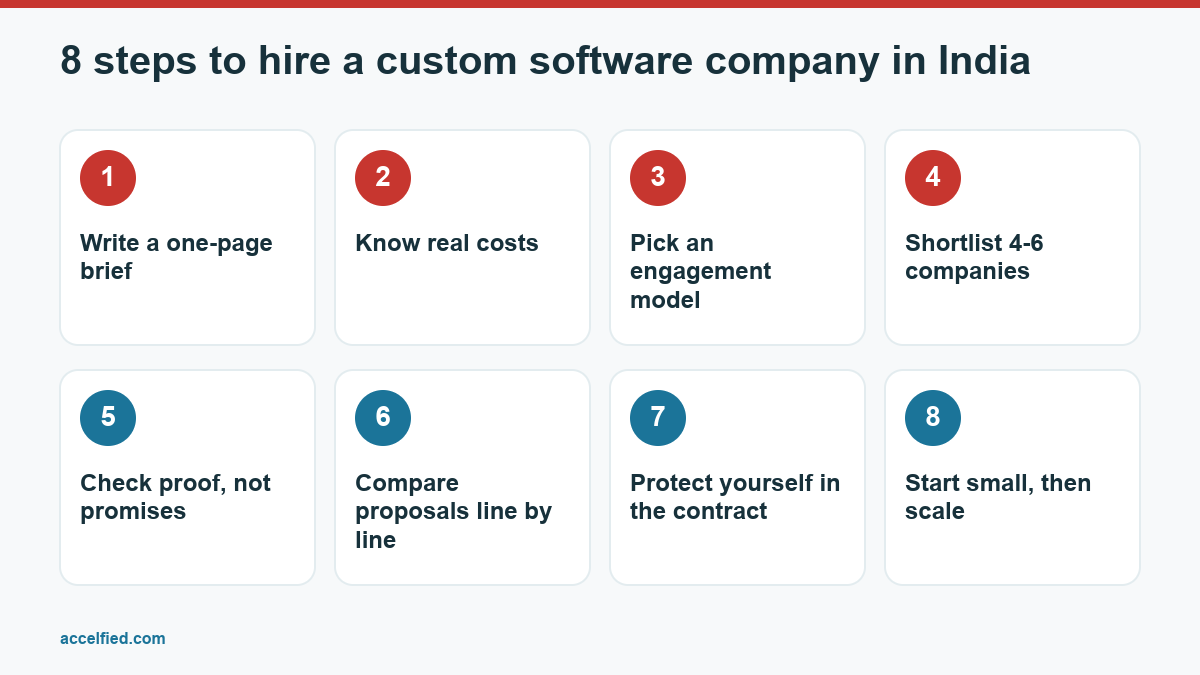
Step 1: Write a one-page brief before you call anyone
You do not need a 50-page specification. You need one page that answers:
- The problem: what is slow, manual or broken today?
- The users: who will use the software, and how many of them?
- Must-have features: the 5-10 things version one cannot launch without
- Integrations: Tally, Zoho, payment gateways, GST e-invoicing, WhatsApp, existing databases
- Budget range and deadline: even a rough range saves everyone time
Companies that receive a clear brief give clearer quotes. Vague briefs get padded quotes.
Step 2: Know what custom software costs in India
Typical 2026 budgets for Indian development companies:
| Project type | Typical budget | Typical timeline |
|---|---|---|
| Internal tool or simple web app | ₹5 lakh - ₹15 lakh | 2-4 months |
| Business system (CRM, inventory, portal) | ₹15 lakh - ₹50 lakh | 4-8 months |
| SaaS product or ERP-level system | ₹50 lakh - ₹1.5 crore+ | 8-18 months |
Hourly rates for Indian development companies mostly range from ₹1,500 to ₹4,000 an hour ($20 to $50). A dedicated developer usually costs ₹1.5 lakh to ₹4 lakh a month depending on experience and stack. Add 18% GST for Indian clients.
If a quote is far below these ranges, ask what has been left out.
Step 3: Pick the right engagement model
| Model | How you pay | Best for |
|---|---|---|
| Fixed price | One price for a defined scope, paid by milestone | Clear, stable requirements |
| Time and material | Hours actually worked, billed monthly | Products that will change as you learn |
| Dedicated team | Monthly fee per developer | Long-running products and ongoing work |
Many good projects combine models: a fixed-price discovery phase of 2-4 weeks (usually ₹50,000 to ₹3 lakh) to map requirements and design screens, followed by time and material or a dedicated team for the build.
Step 4: Build a shortlist of 4-6 companies
Look for companies that have built something close to your project, in your industry or with your stack. Good places to start:
- Review platforms where clients describe real projects, including custom software development companies on Accelfied
- Referrals from businesses in your industry
- Case studies on the company's own site, but only if they name the client
Size matters. A 15-person company will give a ₹10 lakh project senior attention; a 2,000-person firm may hand it to a junior team. Match the company's size to your budget.
Step 5: Check proof, not promises
For each shortlisted company, ask for:
- Two or three live projects similar to yours, with a demo login if possible
- One reference call with a past client, ideally a project that ran into trouble and recovered
- The actual team: names and experience of the project manager and lead developer who will work on your project
- Process: how they plan sprints, test, deploy and report progress
Public reviews help here too. Read the critical ones, not just the five-star ones, and look at how the company responded.
Step 6: Compare proposals line by line
Put every proposal into the same simple sheet: scope covered, team size, timeline, price, payment schedule, warranty and maintenance cost. You will quickly see who left out testing, deployment, documentation or the admin panel.
A good proposal will also list assumptions and what is not included. That honesty is a sign of a company that has done this before.
Step 7: Protect yourself in the contract
Before you sign, make sure the agreement covers:
- IP and source code ownership: all code, designs and documents transfer to you on payment
- Repository access: code lives in a Git repository you own (GitHub, GitLab or Bitbucket) from week one
- Accounts in your name: servers, domains, app store and cloud accounts
- Milestone payments: typically 20%-30% advance, the rest tied to delivered and tested milestones
- Warranty: at least 3 months of free bug fixes after launch
- Maintenance: annual maintenance usually costs 15%-20% of the build cost per year; get it in writing
- NDA and data protection: especially if the software handles customer or payment data
- Exit clause: how handover works if you part ways mid-project
Step 8: Start small, then scale
Instead of signing the full project at once, start with a paid discovery phase or a first module of 4-6 weeks. You will learn more about a company from one month of real work than from any sales call: how they communicate, whether they meet deadlines and how they handle feedback.
Hold weekly demos where you see working software, not just status slides. If after the first milestone you are unhappy, you have lost weeks, not the whole budget.
Red flags that should end the conversation
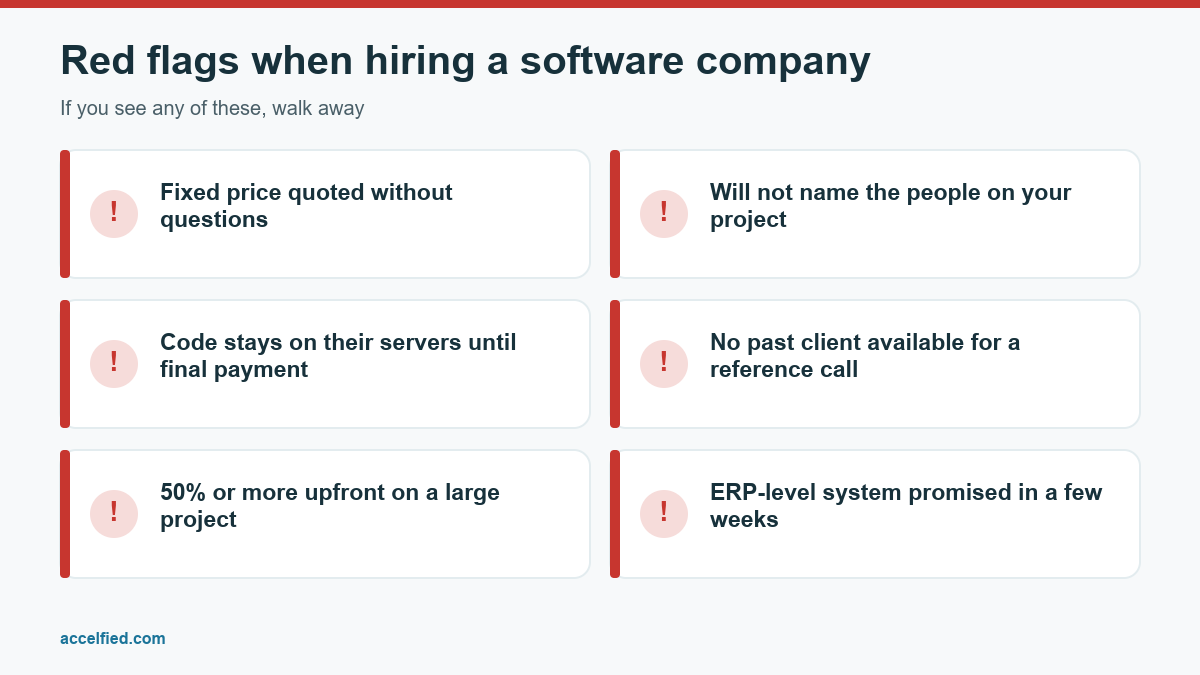
- They quote a fixed price without asking questions about your project
- They will not share the names of the people who will work on it
- Code stays on their servers and you get access "after final payment"
- Every past client is under NDA, so no reference call is possible
- They ask for 50% or more upfront on a large project
- They promise to deliver an ERP-level system in a few weeks
Questions to ask in the first call
- What similar project have you delivered, and can I see it working?
- Who will be my project manager and lead developer?
- How do you estimate, and what happens when scope changes?
- How often will I see working software?
- Who owns the code and when do I get access?
- What does support cost after the warranty ends?
For more questions you can reuse, see our guide on how to choose a web development company in India, and for website budgets, our website development cost in India guide.
Find a software company you can trust
Compare custom software development companies and web development companies on Accelfied, read verified client reviews, or share your project brief and we will suggest companies that fit your budget and timeline.
Run a software development company? Get your company listed and let your past clients' reviews speak for you.
FAQs
How much does it cost to hire a custom software development company in India?
Most custom software projects with Indian companies cost between ₹5 lakh and ₹50 lakh in 2026, depending on features, users and integrations. SaaS products and ERP-level systems can cost ₹50 lakh to ₹1.5 crore or more. Hourly rates usually range from ₹1,500 to ₹4,000.
Which is better: fixed price or time and material?
Fixed price works when your requirements are clear and unlikely to change. Time and material is better for products that will evolve as you get user feedback. Many businesses use a fixed-price discovery phase first, then switch to time and material.
Who owns the source code when I hire a software company?
You should, but only if the contract says so. Make sure the agreement transfers all intellectual property to you and that the code is kept in a repository you own from the start of the project.
How long does custom software development take?
A simple internal tool takes 2 to 4 months, a business system 4 to 8 months, and a large SaaS or ERP-level product 8 to 18 months, including testing and rollout.
- hiring guide
- custom software development
- india